Most organizations are comfortable thinking in terms of enterprises.
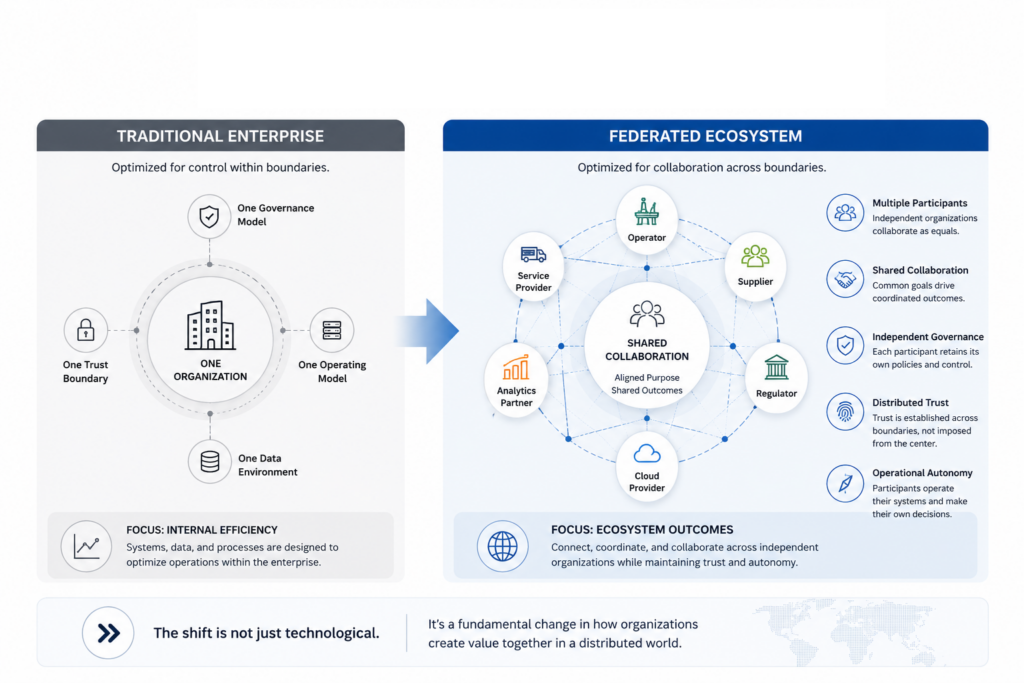
A company has its own systems, its own governance processes, its own infrastructure, and its own operating model. For decades, enterprise architecture largely focused on optimizing within those boundaries. But increasingly, value is being created beyond them.
Today, organizations operate through networks of partners, suppliers, service providers, regulators, contractors, customers, and technology platforms. Business processes no longer begin and end within a single enterprise. They span multiple participants, each with their own systems, policies, objectives, and governance models.
This shift is creating a new operational reality.
Organizations are becoming part of ecosystems. The challenge is that most ecosystems are not centrally owned. No single participant controls all the systems. No single participant owns all the data. No single participant defines all the policies and no single participant governs the entire operating model.
This is where the concept of a federated ecosystem becomes important.
A federated ecosystem is a collaborative environment where independent participants work together while retaining their own governance, infrastructure, and operational autonomy. Rather than centralizing everything into a single platform or organization, federation enables collaboration across distributed environments. Each participant remains independent, each participant maintains control over its own assets and responsibilities , yet the ecosystem can still operate as a coordinated whole.
Consider a modern energy ecosystem.
An operator may collaborate with drilling contractors, service providers, equipment manufacturers, regulators, analytics partners, and cloud providers. Each participant has its own systems. Its own security requirements , its own governance processes and its own business objectives.
Yet meaningful collaboration depends on their ability to exchange information, coordinate activities, and establish trust across those boundaries. The same pattern can be seen in manufacturing, logistics, healthcare, financial services, and public sector initiatives.
The future is increasingly ecosystem-driven. The question is no longer whether organizations can connect systems. The question is whether independent participants can collaborate effectively while preserving governance, trust, accountability, and autonomy.
That is fundamentally a federation challenge. Perhaps this is why many traditional approaches struggle as ecosystems grow. They were designed for enterprises. The future requires architectures that can operate across ecosystems.
A federated ecosystem is not simply a collection of connected organizations. It is a model for enabling collaboration across distributed participants without requiring centralized control.
As enterprises continue to expand their digital relationships, understanding federation may become one of the most important architectural conversations of the next decade.