Most organizations don’t think of trust as an operational problem. Until it becomes one.
When enterprise teams discuss operational efficiency, the conversation typically focuses on technology such as Platforms, Applications, Automation, Data quality and Integration.
Yet some of the biggest inefficiencies in modern organizations have very little to do with technology itself. They emerge from a lack of trust. Not a lack of personal trust. Operational trust.
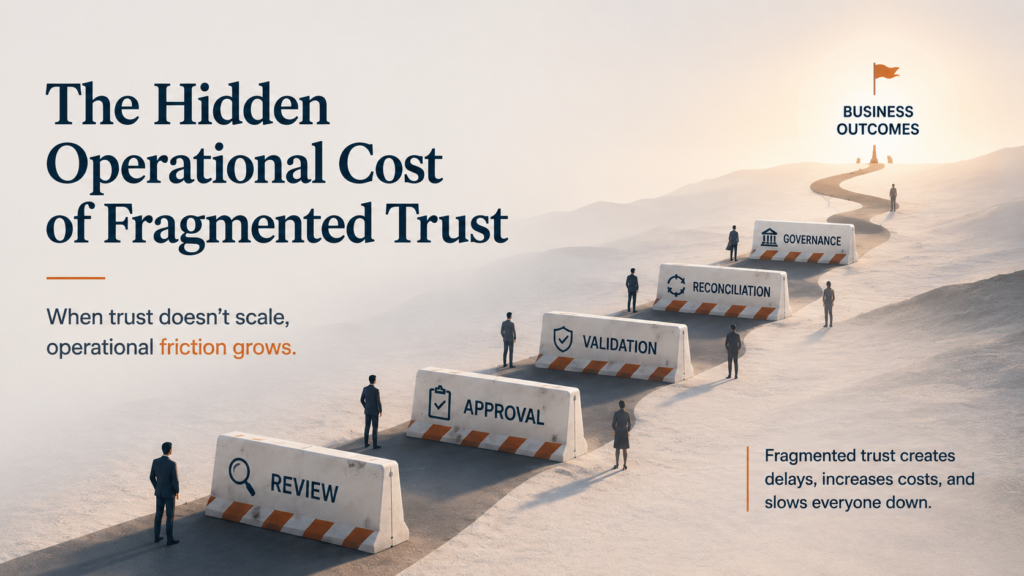
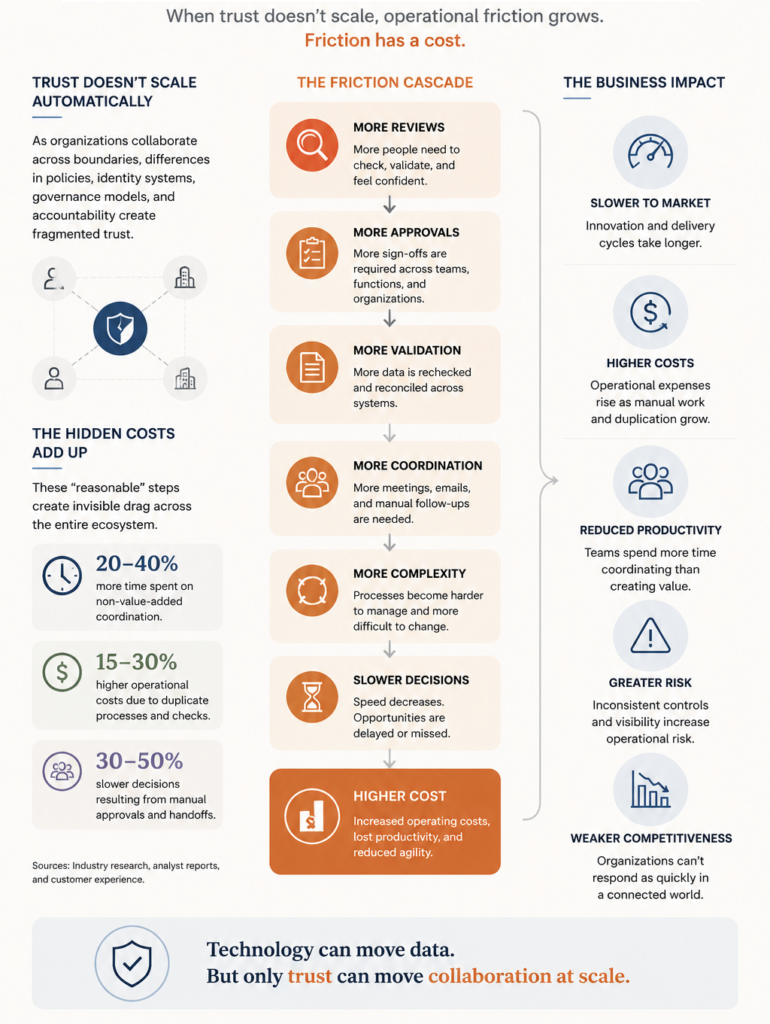
The trust required for systems, teams, business units, partners, suppliers, regulators, and service providers to work together effectively. When trust is fragmented, organizations compensate. They introduce additional reviews , additional approvals, validations, reconciliation processes, governance checkpoints and manual oversight.
Individually, each step appears reasonable. Collectively, they become expensive. A simple decision takes longer, a data exchange requires multiple approvals, information is duplicated across systems, teams spend time validating data they have already received, partners maintain parallel processes to verify the same outcomes, governance becomes increasingly dependent on manual coordination and over time, organizations become accustomed to this operational friction.
It becomes part of how work gets done, but friction has a cost. Projects move slower, operational complexity increases, collaboration becomes more expensive, innovation cycles lengthen and decision-making slows.
The irony is that many of these organizations have already invested heavily in technology modernization. Their systems are connected, data is available, platforms are operational, yet collaboration remains difficult.
Not because the technology is broken, because trust does not scale automatically across organizational boundaries. As enterprises become increasingly connected to partners, suppliers, regulators, and broader ecosystems, this challenge becomes more visible.
Every new participant introduces:
- new policies
- new governance models
- new identity systems
- new accountability requirements
The result is often a growing network of operational workarounds designed to compensate for fragmented trust. Perhaps this is one of the least discussed challenges in enterprise architecture today.
We often talk about moving data, we rarely talk about the cost of trusting it.
The organizations that succeed in ecosystem-driven environments may not be the ones with the most technology. They may be the ones that reduce the operational friction created by fragmented trust.
Because when trust becomes operational, collaboration becomes scalable.