Why Integration Is Not Interoperability
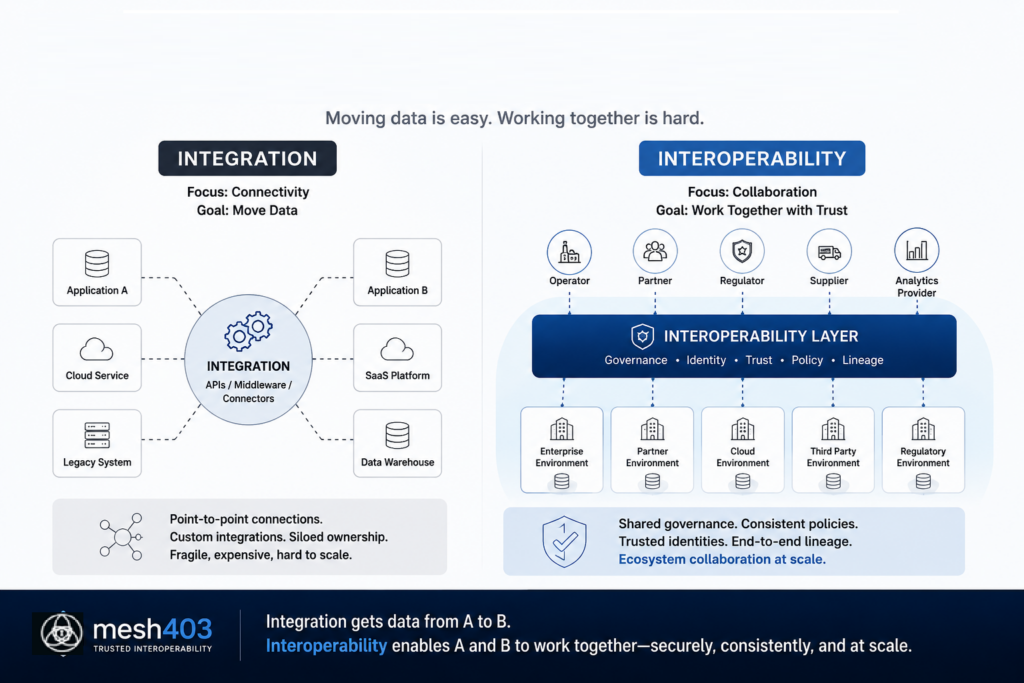
One of the most common assumptions in enterprise architecture is that integration and interoperability are essentially the same thing. They’re not.
In fact, the more organizations invest in integration, the more obvious the distinction becomes. Think about the modern enterprise. Most organizations have spent years connecting applications, building APIs, implementing middleware, deploying event platforms, and integrating cloud services.
Many have hundreds, sometimes thousands, of integrations running across their environments. Yet ask the same organizations whether collaboration is easy across business units, partners, suppliers, regulators, or external ecosystems. The answer is usually very different.
Because integration solves a technical problem. Interoperability solves an operational one. Integration answers the question:
“Can these systems exchange information?”
Interoperability answers a much harder question:
“Can independent parties work together effectively while maintaining trust, governance, and autonomy?”
The distinction becomes obvious when collaboration extends beyond a single environment. Moving data is rarely the difficult part. The difficult part is agreeing on ownership, enforcing policies consistently, maintaining lineage, establishing trust between independent participants, determining who is accountable when something changes.
None of those challenges are solved by another API. This is why so many ecosystem initiatives struggle. The technology works, integrations work. data flows, but collaboration remains slow, expensive, and heavily dependent on manual coordination.
Not because the systems are disconnected. Because the participants are not operating within a common trust and governance model. Perhaps this is why interoperability continues to be discussed despite decades of integration investment.
The industry has become very good at connecting systems. The next challenge is enabling systems, organizations, and ecosystems to collaborate with confidence.
That’s a very different problem.
And it requires a very different way of thinking.