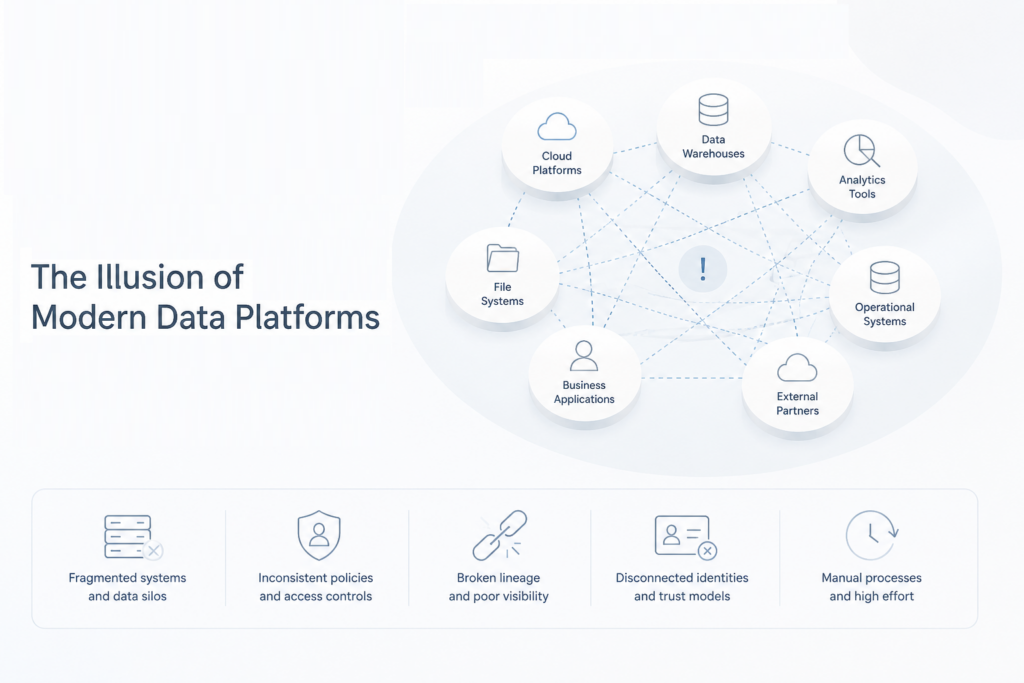
Over the last decade, enterprises have invested heavily in modern data platforms.
Cloud data lakes, governance frameworks, integration platforms, event streaming architectures, and industry standards have fundamentally transformed how organizations manage and access data.
In many ways, these investments have been successful.
Data is more available than ever before.
It can be stored at scale, accessed across teams, processed in near real time, and integrated into increasingly sophisticated analytical workflows.
Yet despite this progress, many organizations continue to struggle with collaboration.
Why?
Because access and interoperability are not the same thing.
Most modern data platforms are designed to solve challenges within a particular environment, business domain, or organizational boundary. They improve visibility, accessibility, and operational efficiency inside the systems they govern.
The real complexity emerges when data needs to move across multiple systems, domains, cloud environments, business units, partners, regulators, or external service providers.
At that point, organizations encounter a very different set of challenges:
- Governance models become inconsistent.
- Identity systems become fragmented.
- Policies are difficult to enforce across environments.
- Lineage becomes harder to maintain.
- Trust becomes increasingly dependent on manual processes and organizational coordination.
The result is an interesting paradox.
Many enterprises appear highly connected from a technology perspective, yet collaboration remains surprisingly difficult from an operational perspective.
The issue is not a lack of data.
The issue is not a lack of platforms.
The issue is that interoperability requires more than connectivity.
It requires trust.
It requires governance.
It requires consistent policy enforcement.
And it requires these capabilities to operate across distributed environments rather than within a single platform.
As organizations increasingly operate across ecosystems rather than isolated enterprises, interoperability becomes less of a technical integration challenge and more of an operational governance challenge.
This shift has significant implications for how we think about enterprise architecture. The next generation of data ecosystems will not be defined by how much data organizations can access. They will be defined by how effectively they can collaborate while preserving governance, trust, and operational autonomy.
The conversation around data is evolving. Perhaps the next challenge is no longer access. Perhaps the next challenge is trusted interoperability.