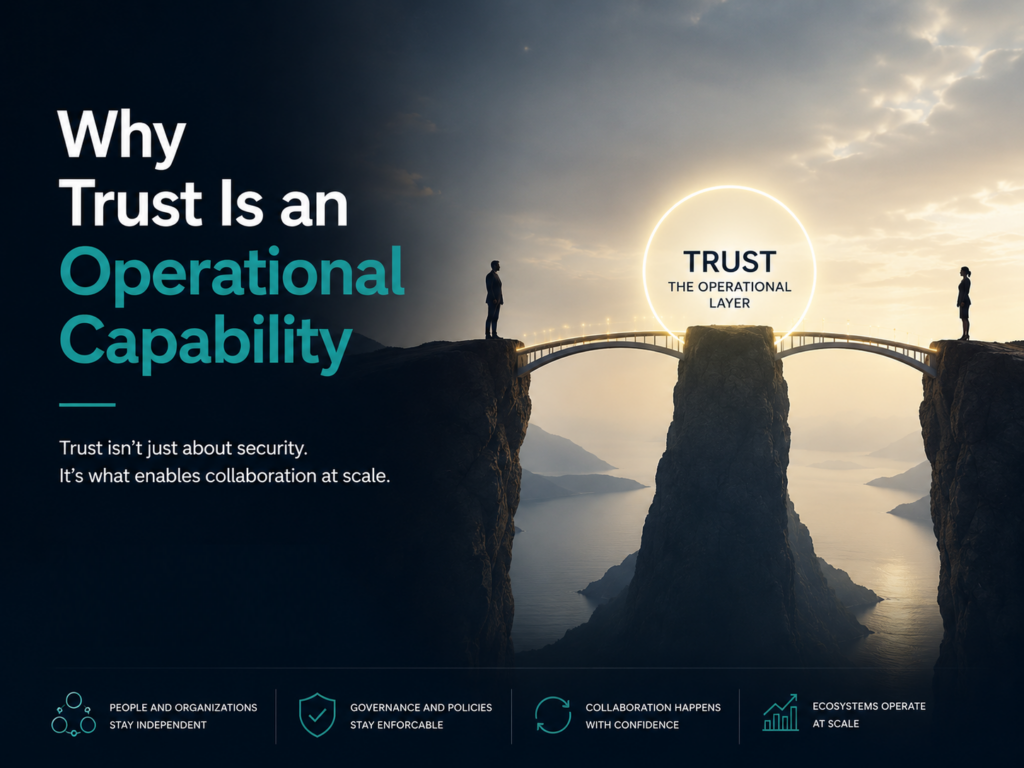
Trust is one of the most frequently used words in enterprise technology. We talk about trusted identities, trusted networks, trusted platforms, trusted data.
But perhaps we’ve been thinking about trust too narrowly.
In many organizations, trust is treated primarily as a security concern. Identity is verified, users are authenticated, access is granted and controls are enforced. These are all essential capabilities. But they don’t solve the broader challenge of collaboration.
As organizations become increasingly connected through partners, suppliers, regulators, customers, and digital ecosystems, trust becomes something much larger than authentication. It becomes operational.
Operational trust is the confidence that allows independent organizations to work together without continuously questioning every interaction. It means knowing that policies have been applied consistently, governance has been respected, data lineage can be verified, participants are accountable for their actions and decisions can be made without unnecessary manual validation.
When operational trust is absent, organizations compensate. More approvals, multiple reviews, more reconciliation and heavy oversight.
Not because people don’t trust each other, because the operating environment doesn’t provide enough confidence to collaborate efficiently. This is why trust should not be viewed as a feature of a security platform, it should be viewed as an enterprise capability that enables collaboration at scale.
In federated ecosystems, every participant maintains its own systems, governance, and responsibilities. No single organization controls the environment, yet collaboration still needs to happen with confidence.
This is precisely the challenge that shaped the mesh403 approach.
We believe trust should not be treated as a by-product of security or an assumption between participants. It should be designed as an operational capability that enables collaboration across distributed organizations.
Rather than requiring organizations to centralize their systems or surrender control of their governance models, mesh403 enables each participant to retain its own autonomy while establishing the confidence needed to collaborate effectively.
Our approach combines governance, trust, interoperability, and governed exchange into a common operational layer. This layer doesn’t replace existing platforms or security investments, it complements them by enabling independent governance domains to work together with confidence.
Operational trust provides that confidence.
As ecosystems continue to expand, the organizations that collaborate most effectively won’t simply have stronger security. They will have stronger operational trust.
Because trust is not the destination.
It’s the capability that makes collaboration possible.